
Rolling Mills
What is a Rolling Mill?
A rolling mill is a manufacturing facility or machine used to reduce the thickness of metal sheets and improve their uniformity through compressive forces. This process helps refine the material’s dimensions, surface quality, and mechanical strength. In stainless steel production, rolling mills are essential for converting raw stainless steel slabs into usable forms like coils or sheets.
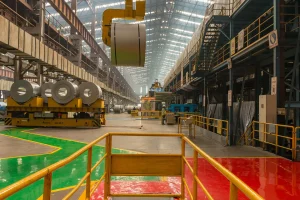
What is a Rolling Mill Used For?
A rolling mill is used to shape, flatten, and finish material by passing it through a series of rollers. The rolling process involves both hot-rolled and cold-rolled stages. The hot rolling process improves the material’s ductility and toughness, while cold rolling refines the surface finish, thickness tolerance, and strength. Intermediate steps such as annealing and pickling are also used to remove surface imperfections and restore the material’s structure.
These mills can perform:
- Hot rolling: Where the material is rolled at high temperatures to improve ductility and reduce thickness.
- Cold rolling: Where the material is further processed at room temperature to enhance surface finish and mechanical properties.
Importance of Rolling Mills in Stainless Steel Production
A multi-stage rolling process combining hot and cold rolling is used to meet international standards for quality, performance, and finish. This makes rolling mills a vital part of their stainless steel production process. Rolling mills play an important role in stainless steel manufacturing, offering several key advantages:
- They ensure precise control over thickness and deliver a consistently smooth surface finish.
- The rolling process enhances essential mechanical properties such as strength, ductility, and toughness.
- Rolling mills support high-volume production of both hot-rolled and cold-rolled stainless steel coils.
- They integrate effectively with additional treatments like annealing and pickling to further improve surface quality and restore material structure.