
Pickling Line (in Stainless Steel Plants)
What is a Pickling Line?
A pickle line is a continuous processing system used in stainless steel manufacturing to remove surface scales, such as oxide layers and mill scale, heat tint formed during hot rolling or annealing. The process involves passing stainless steel coils through a series of acid baths, typically containing nitric acid, hydrofluoric acid, or, in some cases, sulfuric acid.
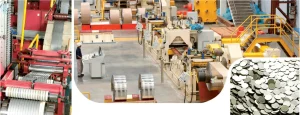
Pickling Process in Stainless Steel
Stainless steel pickling is a process in which the strip moves through multiple stages of chemical treatment, rinsing, and drying. Depending on the product length and production requirements, pickling can be performed using either immersion-type batch pickling or a continuous pickling line (CPL). Modern CPLs may also use electrolytic pickling to improve scale removal efficiency.
The typical CPL process includes:
- Unwinding: The stainless steel coil is unwound and fed into the pickle line.
- Pre-treatment: A descaling/shot-blasting unit may be used to crack and loosen tough oxide layers before acid treatment.
- Pickling: The strip passes through a series of acid tanks containing a mixture of hydrofluoric and nitric acids, which remove residual scales and surface contaminants.
- Rinsing: The treated stainless steel is cleaned with water in rinsing sections to remove loosely bound contaminations and acid residues.
- Passivation: If an additional passivation step is desired, the coils are passed through a tank containing passivation solution (typically nitric acid). This treatment enhances the formation of the chromium oxide (Cr₂O₃) passive layer on the stainless steel surface, improving its corrosion resistance. In some cases, pickling and passivation can be carried out within the same pickling bath, depending on the alloy and the chemistry of the pickling solution. This will again be followed by rinsing process.
- Neutralisation: When removal of residual acid is required, the coil can be passed through a neutralisation tank (containing base such as NaOH solution) as an optional step, followed by rinsing.
- Drying and Oiling: The cleaned strip is dried and lightly coated with oil to prevent oxidation before entering the next operation, often the cold rolling operations.
Importance of Pickling in Stainless Steel Production
The pickle line plays a critical role in ensuring the quality and durability of stainless steel products.
- Restores passivation capability: Pickling removes the oxide scales, heat-affected surfaces and chromium-depleted layers that can form during high-temperature processing, allowing stainless steel to regain its natural protective Cr₂O₃ film on its surface.
- Improves surface finish: By eliminating scales, heat-tint, and contamination, the process provides a clean, uniform surface essential for subsequent processes.
- Prepares for further processing: Cleaned surfaces enhance performance during cold rolling, welding, and surface finish quality, while preventing defects.
Components of a Pickling Line
A modern pickling line has the following components:
- Entry Section: Equipped with uncoilers and entry loopers to feed the coil smoothly into the line.
- Descaling units: Mechanical units that crack heavy scale before pickling.
- Acid Tanks: Contain controlled concentrations of nitric and hydrofluoric acids for oxide removal. Along with Fume extraction systems (essential for handling NOx and HF vapours), Acid circulation & heating systems and Acid regeneration plants. After the pickling operation, optionally, this may include a separate Passivation tank as well.
- Rinsing Units: Wash off residual acid, ensuring a neutral, contaminant-free surface. This may include an optional Neutralisation tank if required.
- Drying Section: Uses hot air or mechanical dryers to remove moisture before further processing.
- Exit Looper and Recoiler: Guide the treated strip out of the line and rewind it into a clean coil for subsequent stages.