
Hot Rolling
What is Hot Rolling of Stainless Steel?
Hot rolling of stainless steel is a metal-forming process where stainless steel slabs or billets are heated above their recrystallisation temperature and passed through rolling mills to achieve the desired shape and thickness.
Hot rolling significantly improves the internal structure of stainless steel. At elevated temperatures, the alloy’s mechanical strength decreases, making the metal softer and easier to deform under pressure. This reduction in strength allows the rolling stands to compress, deform and shape the material efficiently without causing cracking or experiencing excessive loads on the rollers. During this process, the high temperature also enables recrystallisation, breaking down the cast structure, eliminating porosity, and refining the grain structure to improve toughness and uniformity.
The process starts in a reheat furnace, where slabs or billets are heated to the right rolling temperature. They then move through roughing mills, which begin reducing the thickness and shaping the steel. Next, finishing mills take over, refining the final dimensions and surface quality as the hot metal passes through a series of stands. High-pressure descaling systems clean off oxide scale between each stage. Once rolling is complete, the steel is either coiled on a downcoiler or cut into plates, depending on the product needed.
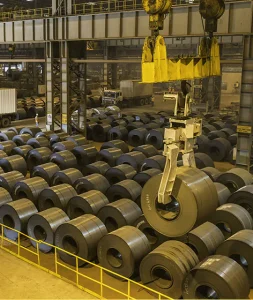
How the Hot Rolling Process Works?
The summary of the hot rolling process involves several controlled stages that transform raw material into usable stainless steel products.
Process steps include:
-
- Reheating: Stainless steel slabs or billets are heated in a furnace, usually above 1100°C.
- Descaling: Using a high-pressure water jet to remove oxide scales formed after the casting process.
- Rolling & Deformation: The heated alloy passes through a series of rolling stands or reduction mills, namely roughing & finishing, where the alloy is gradually thinned and elongated along length.
- Cooling and Coiling: After achieving the required thickness, the hot-rolled sheet is cooled and coiled or cut into plates with the required lengths.
Benefits of Hot Rolled Stainless Steel
Hot-rolled stainless steel combines performance, versatility, and efficiency. It is widely used where strength, formability, and cost-effectiveness are key.
Key benefits include:
- High ductility and workability allow easy shaping and forming.
- Improved mechanical strength is ideal for heavy-duty applications.
- Cost-efficient production lowers energy and tooling costs.
- Excellent metallurgical properties, refined structure ensures durability.
- Thermal stability performs well under heat and stress.
Applications of Hot Rolled Stainless Steel
Hot-rolled stainless steel plays a major role in industries that demand strength, toughness, and scale. Its versatility makes it suitable for a wide range of uses.
Common applications include:
- Construction materials: beams, columns, and load-bearing structures
- Industrial machinery: components for heavy-duty processing equipment
- Pressure vessels and boilers: for chemical and energy industries
- Automotive components: chassis, frames, and body reinforcements
- Heavy gauge products: stainless steel plates, pipes, bars, and coils